
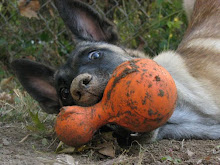
Mika is my 18-month old Belgian Malinois, and like most Malinois she is so full of drive it manifests itself in everything she does. She doesn't do anything mildly; every move she makes, whether pursuing a ball or licking my face, is filled with intensity of purpose.
From the moment she wakes, she unashamedly seeks to satisfy her own interests. The whole world is for her and it never occurs to her that my favorite pair of boots she's set her sites on is not for the sole purpose of her chewing delight. And even when she's gracious enough to let me pry the boots from her steal-trap jaw, it's only because she thinks she'll get some other reward in its place.
A human who lived life the same way my Mika does would be perceived as narcissistic, but dogs operate in an amoral mindset; they lack the social constructs that make selfishness wrong. Jean Donaldson put it best in her book, Culture Clash, when she said, "dogs are completely and innocently selfish." Unfortunately in an age where people have pets as substitute children, its difficult for people to recognize that dogs are selfish creatures, and that's okay. Instead we tend to assign human qualities to our pets and hold them to human standards.
Dogs don't think the way that humans do and our failure to recognize this in our day-to-day interactions with dogs is a huge failing on our part. If we see dogs as having human-like qualities, then when our dogs do something we don't like we tend to rationalize things in human terms and this usually leads us to feel like the dog knows better, that the offense was a personal affront, that the dog looks guilty. This line of thinking tends to elicit a desire to punish the dog. But the truth is the dog was neither vindictive in her actions nor did she feel guilty. Her brain isn't hardwired to feel those things and punishing her for acting on feelings she doesn't really posses is, well, confusing at best, if not an abuse of control.
The classic example of this is the dog who soils the carpet while his owner is at work. The owner comes home, finds the mess, and punishes the dog. The dog perceives a change in the owners demeanor, and fearing the punishment to come (since it's not the first time his owner's acted this way) will offer a "conciliatory" look in an attempt to quell the owners negative reaction. The owner perceives the dog's "look" as guilt and therefore believes the dog knows better, that the "accident" is not really an accident but instead a malicious act. "Why does she keep doing this? She knows better!"
The truth is, if there is a break-down between what you want the dog to do and how the dog is actually behaving, the break down is with you, the human. The dog is either:
I am the first person to admit to loving my dogs as though they are my babies, but I know at the end of the day I have nobody to blame for my dog's behavior--good or bad--but myself. Even when it's my favorite shirt she just ripped to shreds!!!
From the moment she wakes, she unashamedly seeks to satisfy her own interests. The whole world is for her and it never occurs to her that my favorite pair of boots she's set her sites on is not for the sole purpose of her chewing delight. And even when she's gracious enough to let me pry the boots from her steal-trap jaw, it's only because she thinks she'll get some other reward in its place.
A human who lived life the same way my Mika does would be perceived as narcissistic, but dogs operate in an amoral mindset; they lack the social constructs that make selfishness wrong. Jean Donaldson put it best in her book, Culture Clash, when she said, "dogs are completely and innocently selfish." Unfortunately in an age where people have pets as substitute children, its difficult for people to recognize that dogs are selfish creatures, and that's okay. Instead we tend to assign human qualities to our pets and hold them to human standards.
Dogs don't think the way that humans do and our failure to recognize this in our day-to-day interactions with dogs is a huge failing on our part. If we see dogs as having human-like qualities, then when our dogs do something we don't like we tend to rationalize things in human terms and this usually leads us to feel like the dog knows better, that the offense was a personal affront, that the dog looks guilty. This line of thinking tends to elicit a desire to punish the dog. But the truth is the dog was neither vindictive in her actions nor did she feel guilty. Her brain isn't hardwired to feel those things and punishing her for acting on feelings she doesn't really posses is, well, confusing at best, if not an abuse of control.
The classic example of this is the dog who soils the carpet while his owner is at work. The owner comes home, finds the mess, and punishes the dog. The dog perceives a change in the owners demeanor, and fearing the punishment to come (since it's not the first time his owner's acted this way) will offer a "conciliatory" look in an attempt to quell the owners negative reaction. The owner perceives the dog's "look" as guilt and therefore believes the dog knows better, that the "accident" is not really an accident but instead a malicious act. "Why does she keep doing this? She knows better!"
The truth is, if there is a break-down between what you want the dog to do and how the dog is actually behaving, the break down is with you, the human. The dog is either:
- Not completely trained to understand the behavior in the context in which you have asked her to preform it.
- The dog is unmotivated and needs a more high-value reward to work for.
- The environment is too distracting and your expectations are too high.
I am the first person to admit to loving my dogs as though they are my babies, but I know at the end of the day I have nobody to blame for my dog's behavior--good or bad--but myself. Even when it's my favorite shirt she just ripped to shreds!!!


 Posts
Posts


No comments:
Post a Comment